Find a website before finding work
Navigation is organized around vendors instead of the work that needs to happen today.
ONESTACK CONTROL / UNIFIED OPERATIONS
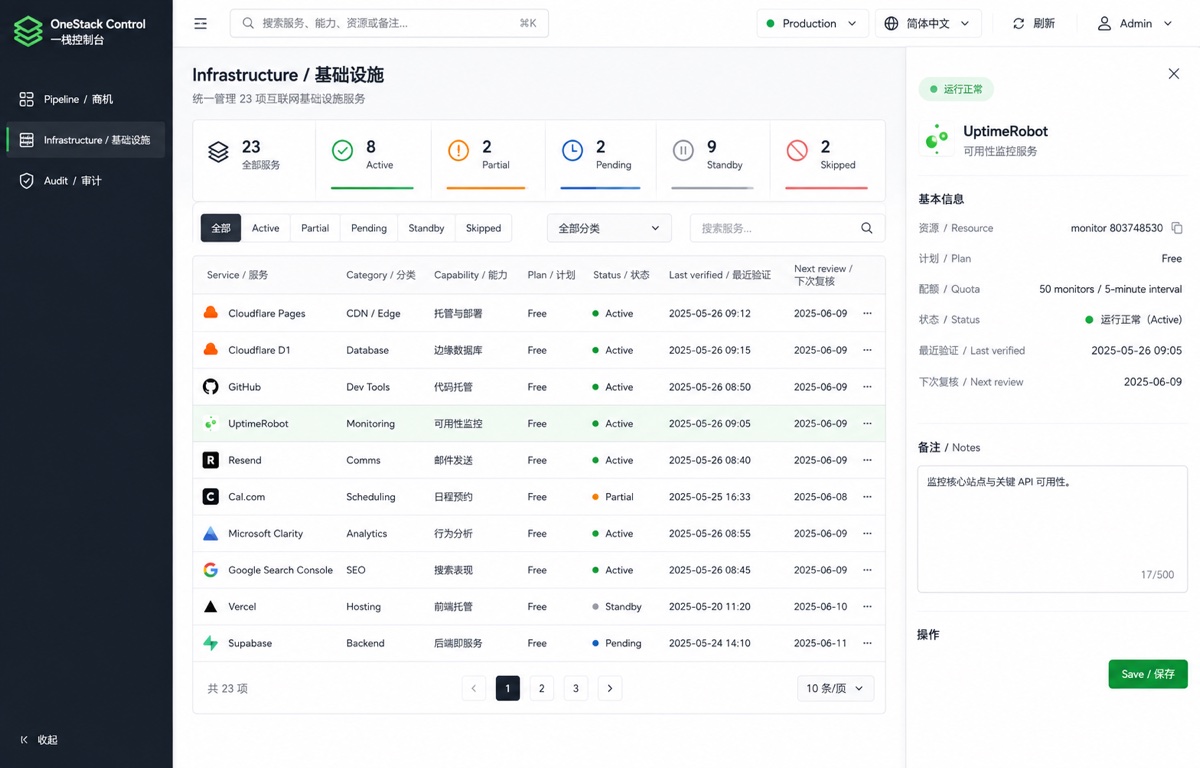
No wholesale rebuild required. Bring pipeline, infrastructure, market signals, and isolated test environments into one workspace so the team sees the next decision before opening another tool.
Each tool uses direct API actions, a secure handoff, or read-only monitoring according to its capabilities.
01 / WHY
When leads, mail, deployment, research, and testing live on separate websites, the owner repeatedly signs in, finds records, decides priority, and reconciles status by hand.
Navigation is organized around vendors instead of the work that needs to happen today.
Dashboards show numbers but provide no direct action, failure feedback, or manual fallback.
Disposable mail and test services can be misused for real accounts when isolation is not explicit.
02 / OPERATING MODEL
The control center does not replace every tool. It adds a common task, action, state, and audit model above them.
Combine new leads, overdue follow-ups, tool alerts, and high-intent signals.
Run checks, collection, updates, and triggers directly; hand off safely where needed.
Track health, last verification, next review, owner, and credential location.
Use one-time codes or backup passwords and record material changes and outcomes.
03 / INTEGRATION MODES
For tools with a stable API or webhook.
Examples include health checks, market collection, state updates, and workflow triggers.
For tools whose authentication remains vendor-managed.
The workspace shows status, ownership, and the correct entry without copying passwords or forcing an iframe.
For services without immediate automation value.
Track plan, limits, last verification, and next review in a common registry.
04 / ENVIRONMENTS
Real leads, deployments, notifications, and market information. Actions require authentication and material changes are recorded.
Only for development and mail-flow verification. It must not receive real account, security, or other sensitive messages.
05 / FAQ
No. Tools with stable APIs can expose direct actions. Tools limited by authentication, cross-origin, or security policies use a controlled handoff while the workspace retains status and context.
Each environment has distinct status labels, permission boundaries, and action paths. Disposable mail tools such as Inbucket remain isolated and are never used for real accounts or sensitive verification messages.
Yes. Start with a tool registry and priority queue, then add direct actions in order of business value. A wholesale system replacement is not required.
The free audit defines the entry point, actions, access boundaries, and first-stage scope.